Exploring the impact of Green Roofing Trends on the global construction landscape, this introduction sets the stage for a fascinating discussion on the evolution and significance of green roofs in today's construction industry.
Providing insights into the different types of green roofing systems and their benefits, this overview aims to shed light on the progressive shift towards sustainable construction practices worldwide.
Overview of Green Roofing Trends
Green roofing, also known as eco-roofing or living roofing, involves the installation of vegetation and a growing medium on a building's roof. This sustainable roofing option is gaining popularity in the construction industry due to its environmental benefits and energy-saving properties.
Evolution of Green Roofing Trends
Green roofing trends have evolved significantly over the years on a global scale. Initially, green roofs were primarily used for their aesthetic appeal and environmental benefits. However, with the increasing focus on sustainability and energy efficiency, green roofing has become a mainstream choice for many construction projects.
Benefits of Green Roofing
- Enhanced Insulation: Green roofs provide natural insulation, reducing the need for heating and cooling, thus lowering energy costs.
- Stormwater Management: Green roofs absorb rainwater, reducing runoff and the strain on drainage systems.
- Improved Air Quality: The vegetation on green roofs helps filter pollutants and CO2 from the air, leading to cleaner air in urban areas.
- Extended Roof Lifespan: The protective layer of vegetation on green roofs can prolong the lifespan of the roof membrane by shielding it from UV rays and extreme temperatures.
Types of Green Roofing Systems
Green roofing systems come in various types, each with unique features and advantages that cater to different construction needs.
Extensive Green Roofs
- Extensive green roofs are lightweight and low-maintenance, typically featuring shallow soil depths of 2-6 inches.
- These roofs are ideal for retrofitting existing buildings and are cost-effective to install.
- Notable examples include the Chicago City Hall in the United States and the Vancouver Convention Centre in Canada.
Intensive Green Roofs
- Intensive green roofs have deeper soil layers, ranging from 6 inches to several feet, allowing for a wider variety of plants and landscaping options.
- These roofs are more labor-intensive and require irrigation systems, but they provide additional green space for recreational activities or gardens.
- Notable examples include the California Academy of Sciences in San Francisco and the Marina One in Singapore.
Semi-Intensive Green Roofs
- Semi-intensive green roofs fall between extensive and intensive systems, offering a balance of low maintenance and design flexibility.
- They typically have soil depths between 6-12 inches and can support a mix of vegetation types.
- Notable examples include the Bosco Verticale in Milan, Italy, and the COFCO Plaza in Beijing, China.
Sustainability Impact of Green Roofing
Green roofing has a significant impact on sustainability, offering a range of environmental benefits that contribute to a greener and healthier urban environment
Reducing Energy Consumption
Green roofs play a crucial role in reducing energy consumption in buildings by providing natural insulation. The vegetation and soil on green roofs act as a barrier, reducing the need for heating in winter and air conditioning in summer. This leads to lower energy usage and decreased reliance on artificial climate control systems.
Mitigating Urban Heat Island Effects
Urban heat islands are areas where urban development has caused temperatures to rise higher than in surrounding rural areas. Green roofs help mitigate these effects by absorbing heat and providing evaporative cooling, reducing the overall temperature of urban areas. This not only improves the comfort of residents but also helps lower energy demand for cooling buildings.
Promoting Biodiversity and Improving Air Quality
Green roofs contribute to promoting biodiversity in urban areas by providing habitats for birds, insects, and plants. This helps support local ecosystems and increase urban biodiversity. Additionally, the vegetation on green roofs helps improve air quality by absorbing pollutants and carbon dioxide, while releasing oxygen through photosynthesis.
This natural process helps reduce air pollution and creates a healthier environment for urban dwellers.
Technology and Innovation in Green Roofing
Green roofing is constantly evolving, with technological advancements playing a crucial role in shaping the industry. Innovations in materials and installation techniques have significantly improved the efficiency and effectiveness of green roofs, making them more sustainable and cost-effective solutions for modern construction projects.
Modular Green Roof Systems
Modular green roof systems have emerged as a game-changer in the construction industry. These systems consist of pre-assembled modules that can be easily transported and installed on rooftops, reducing labor costs and installation time. By implementing modular green roof systems, construction projects can achieve faster completion times and minimize disruptions to the surrounding environment.
Smart Technologies for Monitoring and Maintenance
The integration of smart technologies in green roofing has revolutionized the way these systems are monitored and maintained. Sensors and monitoring devices can collect real-time data on factors such as moisture levels, temperature, and plant health, allowing for proactive maintenance and optimization of green roofs.
By leveraging smart technologies, building owners can ensure optimal performance and longevity of their green roof investments.
Concluding Remarks
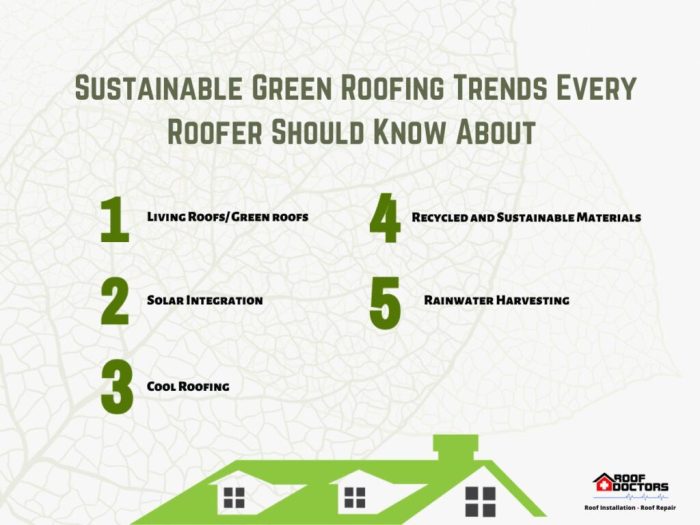
In conclusion, the influence of Green Roofing Trends in shaping the future of global construction cannot be underestimated. From enhancing energy efficiency to promoting biodiversity, green roofs are paving the way for a greener and more sustainable built environment.
Query Resolution
What are the primary benefits of incorporating green roofing in construction projects?
Green roofing can improve energy efficiency, reduce urban heat island effects, promote biodiversity, and enhance air quality in urban areas.
How have green roofing trends evolved globally over the years?
Green roofing trends have evolved to include various innovative systems and technologies that enhance sustainability and environmental impact in construction practices.
What role do green roofs play in mitigating urban heat island effects?
Green roofs help reduce the heat absorbed and radiated by buildings and pavement in urban areas, thereby mitigating the urban heat island effect.